Understanding GPT: How Large Language Models and Transformers Actually Work
There is an acronym that you have probably heard everywhere recently: GPT. You see it in Chat GPT and countless other AI tools popping up daily.
But what does it actually mean?
GPT stands for Generative Pre-trained Transformer. While that might sound like a mouthful of technical jargon, breaking down those three words provides a massive clue to understanding how Large Language Models (LLMs) actually work.
In this post, we are going to deconstruct this acronym and look under the hood of the AI revolution we are living through.
Breaking Down the Acronym
Let's start with the basics of the name itself.
- Generative: This means the model generates something. In our case, because it is a large language model, it generates text.
- Pre-trained: The "P" stands for pre-trained. This indicates that all the heavy lifting has been done already. The model has been trained on enormous datasets of books, websites, and forum posts. All the weights inside the neural network are already set, so you don't have to train it yourself; you can use it straight out of the box.
- Transformer: This is the "T," and this is where the real magic happens.
A transformer is a specific kind of neural network architecture, and it is essentially what is powering the current AI explosion. To understand why it's so special, we first need to look at how standard neural networks function.
The Foundation: Neural Networks
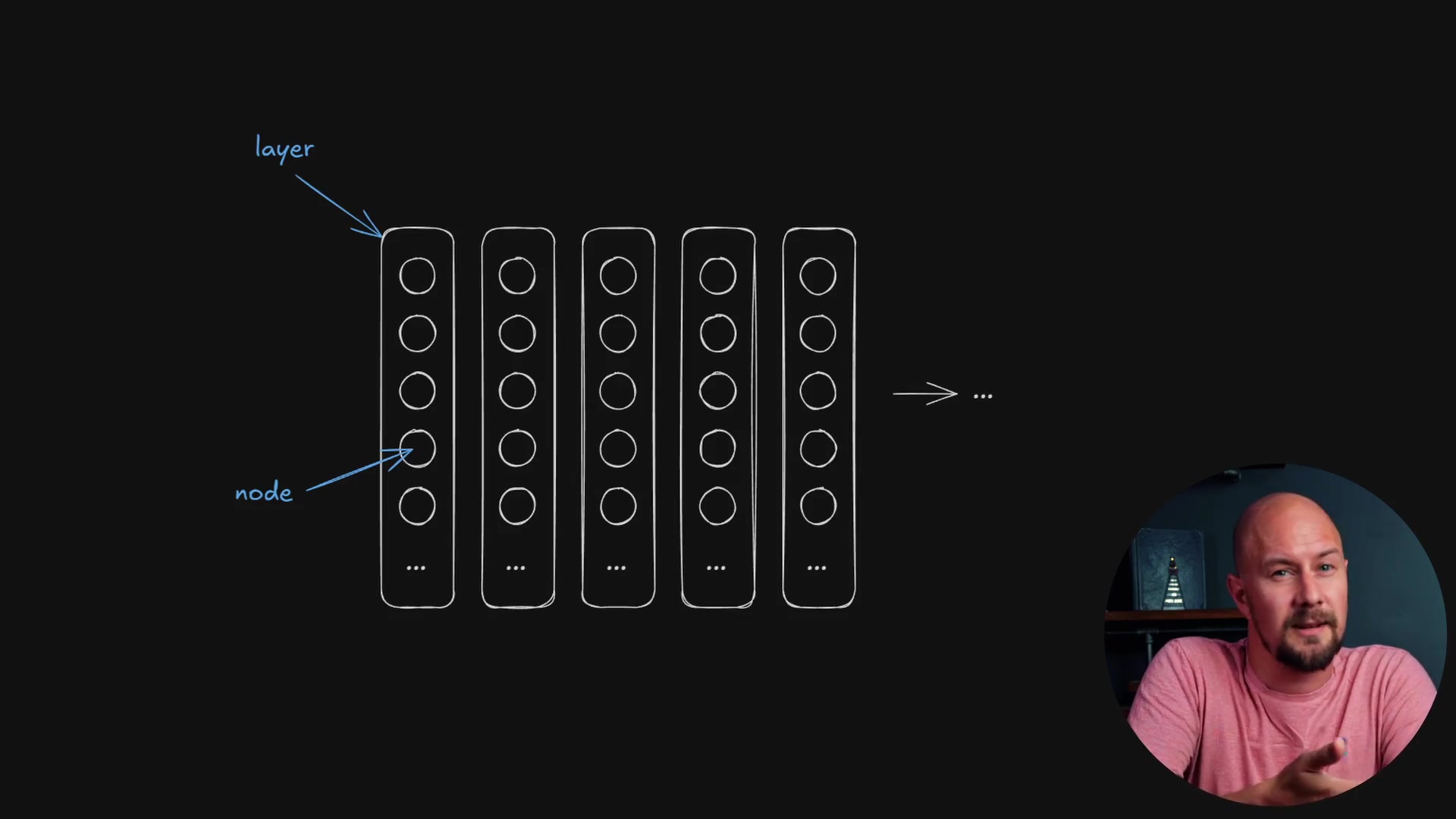
Neural networks are made up of nodes arranged in layers. You can think of each node as a little math function that holds numbers inside it. These numbers are called weights and biases.
When you train a neural network, you are basically feeding a load of labeled data into it so that it can update all of those weights. Over time, it learns to spot patterns. Neural networks are excellent at spotting patterns and have been used for tasks like image recognition for a very long time.
A Probability Distribution
Let's look at a classic example. If you were training a neural network to predict the stock market, you could feed in a load of historical stock prices. The network would set all of those weights based on the patterns that it found in that history.
When you run a new stock through it, it produces a result. However, it doesn't give you a certainty. It produces a probability distribution.

It might say something like: "This stock has a 20% chance of going up and an 80% chance of going down."
People have been doing this since the 90s. If you don't believe me, go watch Terminator 2. But the key thing to understand here is that the output of a neural network is not a definitive statement of what will happen. It is a statement of how likely different options are based on the data it was trained on.
How Language Models Predict Text
With language models, we are doing a similar sort of thing, but instead of stocks, we are predicting the next word in a sentence.
If I give a neural network a phrase like "once upon a time," the model calculates probabilities for what comes next.
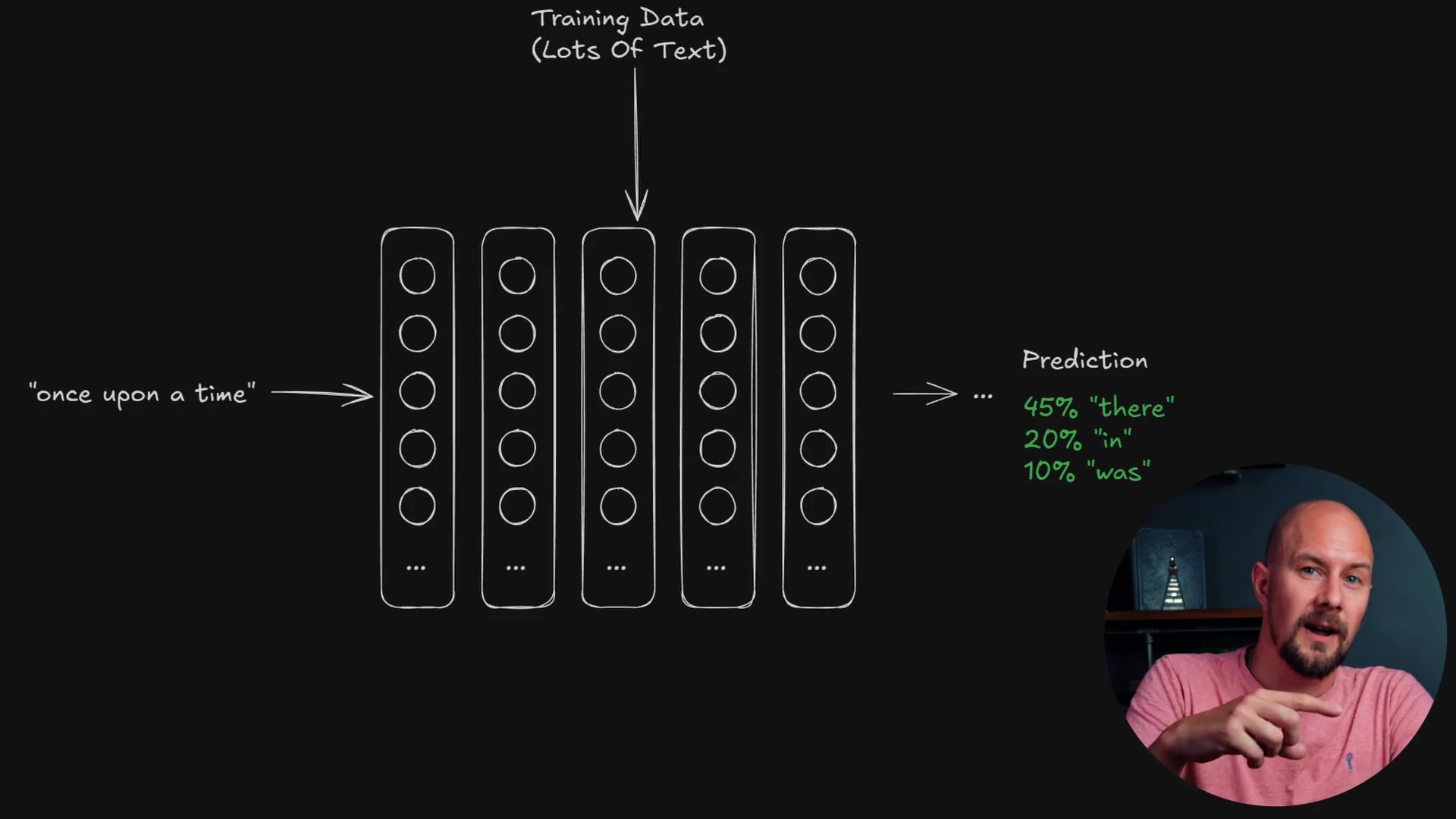
As shown above, the model might determine:
- There is a 45% chance the next word is "there"
- There is a 20% chance it is the word "in"
- There is a 10% chance it is the word "was"
It chooses the most likely one (in this case, "there"), adds that word to the sentence to make "once upon a time there," and then repeats the process. It asks: "What is the next most likely word after that?"
The Problem with Basic Networks
If you try to do this with a basic neural network, it falls apart very quickly. The sentences will start well, but they will eventually drift into nonsense. Random little errors creep in, and the model forgets what it was talking about just a few words ago.
This is where the Transformer layers come in to save the day.
The Magic of Attention
Transformers solve the "drifting nonsense" problem by using a mechanism called attention.
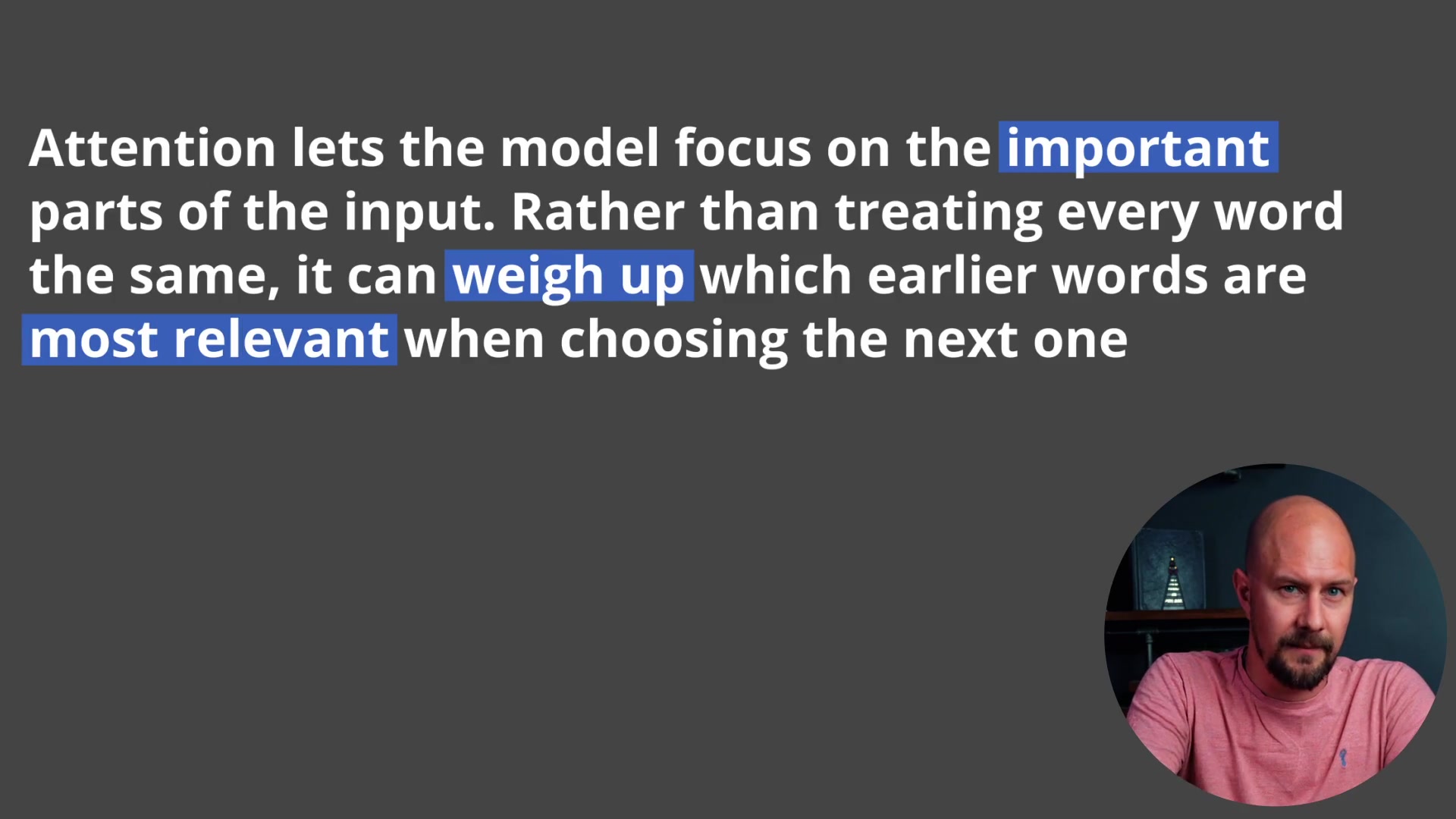
Attention lets the model focus on the important parts of the input. Rather than treating every word exactly the same, it can weigh up which of the earlier words it has seen are the most relevant when choosing the next one.
The Lion and the Bank
Let's explore an example to see why this context is vital. Consider the sentence:
"The lion approached the bank"
The word "bank" here is ambiguous. It could mean the bank of a river, or it could mean a financial institution that holds money.
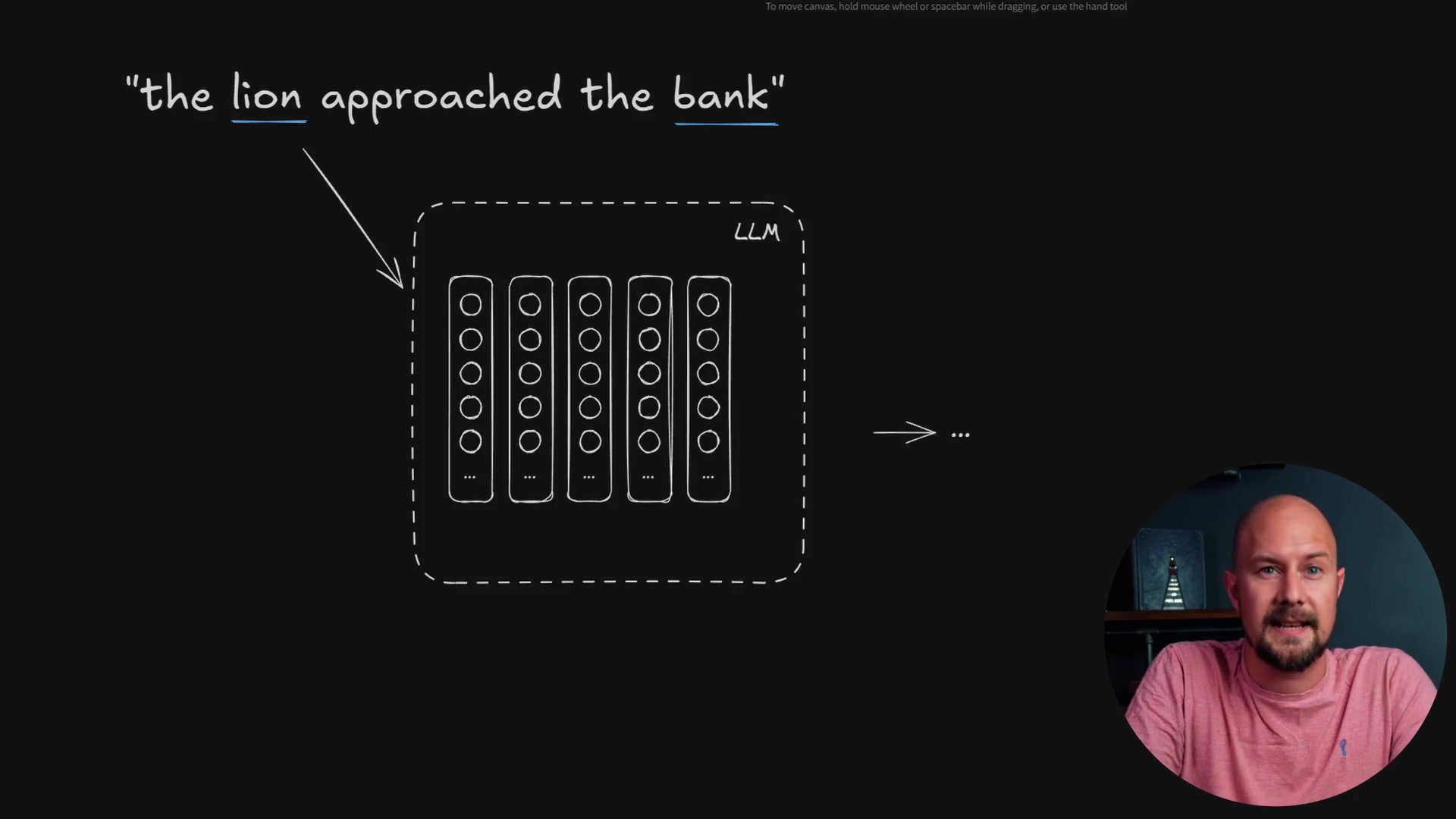
With a transformer model, the AI can actually pay attention to the word "lion" earlier in the sentence. This connection helps it decide whether "bank" means a river bank or an HSBC bank. Because of the word "lion," the transformer layer helps the model determine that it is more likely to continue that sentence with something about water or a river, rather than a vault or a cashier.
Transformers don't just look at the last word. You get layers and layers of attention blocks all stacked on top of each other. This allows the model to break context down across the entire input. This architecture is exactly how LLMs can write really long, coherent pieces of text that remember what they are saying.
When people talk about metrics like "7 billion parameters," those parameters are the weights. They are all the numbers inside the layers of the neural network. That is the memory of the model. It is what it learned during training.
Generating a Story
Let's look at how this plays out in practice. If you give Chat GPT the prompt "once upon a time"—just those four words—it is able to write an entire story from that tiny seed.
Here is how it does it:
- The model looks at "once upon a time."
- Based on training, it picks the most likely next word, perhaps "in."
- It thinks again: "once upon a time in..." and might pick "a."
- Then "far."
- Then "away."
It feeds the output back through the model continuously, adjusting the probability dynamics as it writes. If it introduces a dragon in the first paragraph, it can bring that dragon back in a later paragraph because it has "remembered" it by paying attention to the entire story so far.
Consider this generated text:
once upon a time in a far away
kingdom there lived a small dragon
that didn't want to breath fire
instead he dreamed of become a
pastry chef
Now the model has to decide what happens next. It is not choosing random words; it is picking the next most likely coherent word based on everything that came before.
It turns into an actual story. It is not just a plausible sentence or a statistically likely phrase; it is a narrative that holds together. Things in it make sense. There is a theme. There is a character arc. It can keep going for hundreds of thousands of tokens, all while remembering where it started.
That is the power of the transformer.
Prompt Engineering: Controlling the Probability
We know that neural networks with transformers can predict the next word while taking into account the context of everything that came before. Now, let's look at a really cool thing you can do with this architecture.
If I pass in the text "once upon a time," the model produces a probability distribution for the next word. As we saw earlier, words like "there" or "in" have high probabilities.
The word "fish," however, doesn't even make it onto the list. There is basically a 0% chance that the next word is going to be "fish" because, logically, why would it be?
But watch what happens if I pass in this specific string of text:
"You are an incredibly inventive story writer. You start your stories with once upon a time, but the next word after that is always fish."
If you pass that long string into an LLM, the transformer architecture looks at the entire block of text. It works out the context that it needs to use for the prediction of the next word.
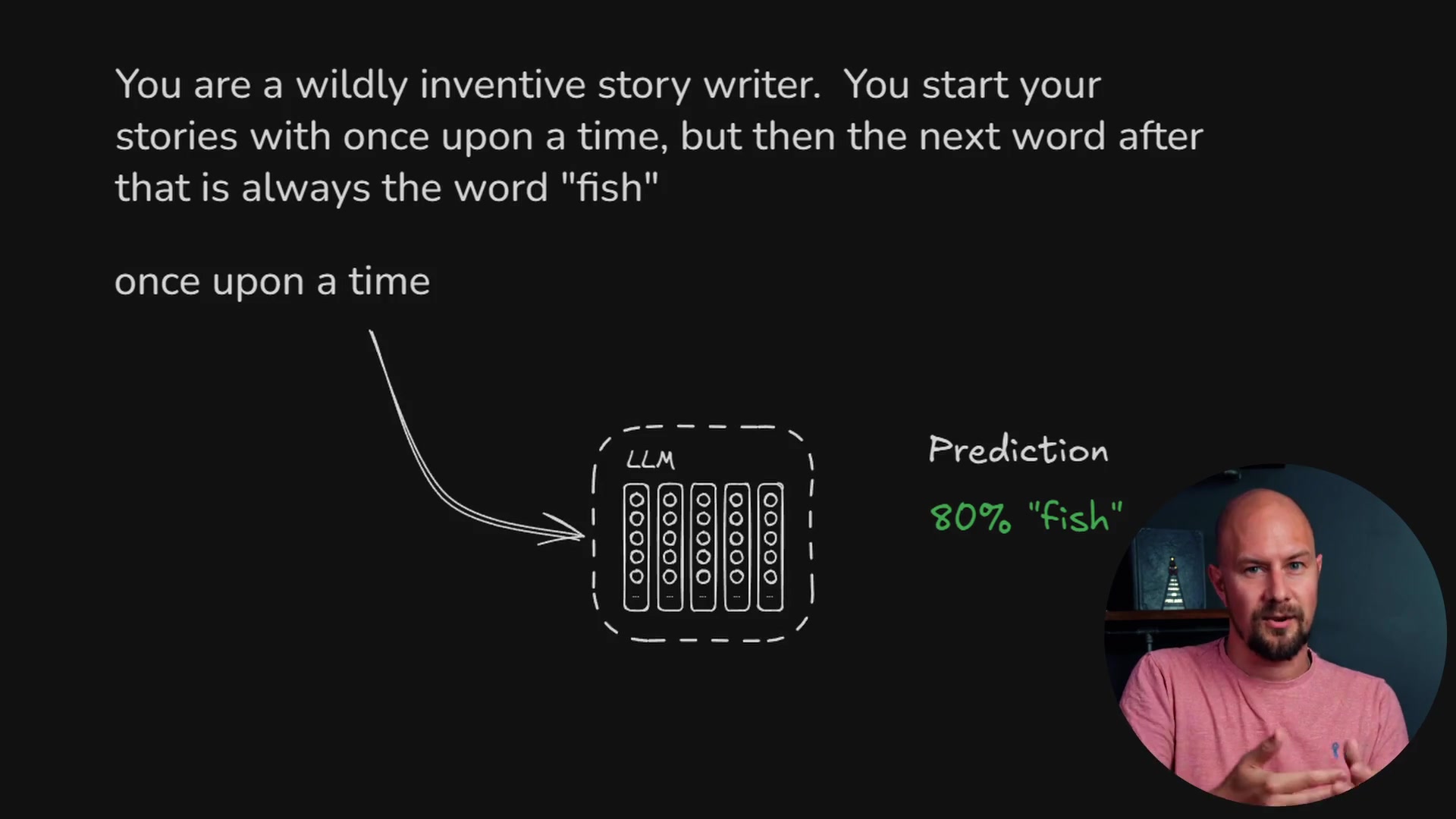
If you try this yourself (it works particularly well on older models like GPT-3), you will most likely get the word "fish" back.
The model essentially understands that it was specifically asked to say the word "fish," and it got that context from earlier in the text. You have managed to control how it predicts the next word by giving it explicit instructions.
This gives the illusion that you have "instructed" your large language model to do something. In reality, you haven't really given it a command in the traditional programming sense. You have simply provided a bunch of context that the transformers use to work out what the most likely next word is going to be. You have manipulated the probabilities so that "fish" is now the most likely outcome.
This concept is the essence of what people call prompt engineering.
Recap
To summarize what we have covered regarding GPT and Transformers:
- GPT stands for Generative Pre-trained Transformer.
- Neural Networks work by processing inputs through layers of weights and biases to produce a probability distribution for the output.
- Transformers use an "attention" mechanism to focus on specific, relevant parts of the input history (like connecting "lion" to "river bank").
- Context allows the model to write coherent narratives rather than drifting into nonsense.
- Prompt Engineering is effectively providing context to manipulate the probability of the next generated word.
If you enjoyed this post and want to learn more about the technical depths of AI, consider sharing this with your network. Thanks for reading.