From Chatbot to AI Agent: Understanding Reasoning and the Agent Loop
So, now you have a C# application talking to an LLM. It can complete some text, it can chat with the user, and it can even make tool calls. However, that still isn't really an "agent." There is one big piece missing, and that piece is reasoning.
Reasoning is the ability for an AI agent to make decisions. It goes beyond just predicting the next word; it involves deciding "what should I do next?" It is the difference between using a calculator (which just processes input) and talking to a real person who understands your goal and helps you work out how to get there.
The Agent Loop
If you just have a chat model, you give it a question, and it gives you an answer. That is a single-shot process. It is done immediately. However, an agent needs to think in steps. An agent needs to look at the current situation and decide if it has all the information required to complete its action or goal.
If it does not have enough information, it must decide where to get it. It might call a tool, or it might ask you a question. Then, it takes that new information, thinks again, and continues until it is satisfied that it has everything needed to do the job. Finally, it takes an action.
This process is what we call the Agent Loop.
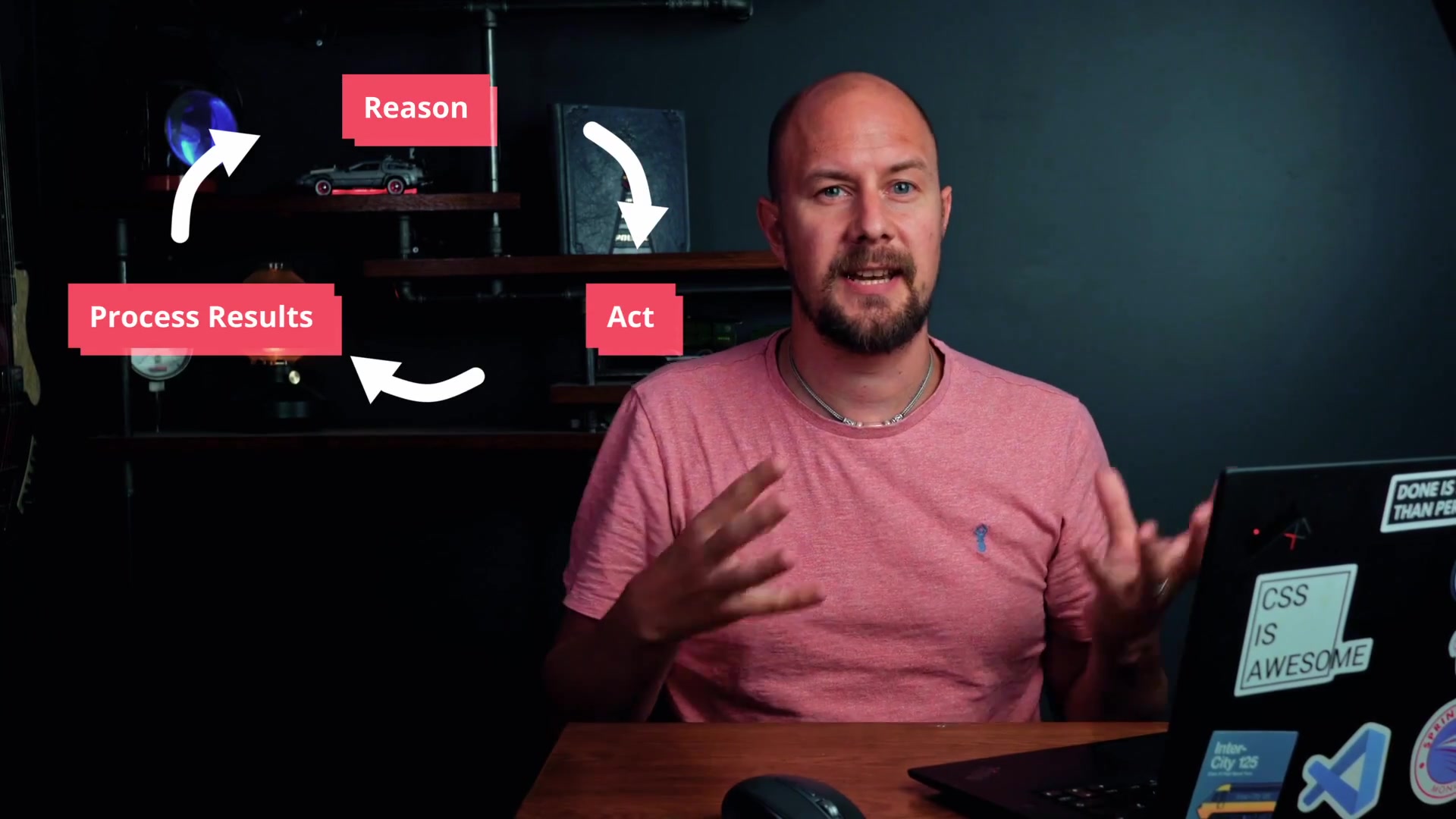
As shown above, an agent loop is like a feedback cycle for AI. You give it a goal, and it starts by:
- Planning and taking action (Reason/Act).
- Evaluating the result (Process Results).
- Deciding what is next.
- Repeating the cycle until the goal is reached.
Reactive vs. Proactive AI
There is a key difference here. A pure LLM is reactive. It only does something when you poke it or ask it to perform a specific task. An agent is much more proactive. An agent can decide for itself what the next steps should be.
Let's look at an example regarding planning a trip to New York.
The Basic LLM Approach
With a basic LLM, even with tool calling, you act as the driver. You might ask, "What is the cheapest flight from London to New York next month?"
The AI goes off, calls a tool (or a couple of tools), and comes back with dates and prices. That is great, but in this case, the AI is acting like a glorified search engine. You have to ask it specifically what you want to do at every step.
The Agent Approach
With an agent, you can provide your high-level goal, and it uses reasoning to work out the best way to achieve that goal. You might say:
"Plan me the cheapest possible New York trip next month, including accommodation."
If you give it that prompt, the agent creates a plan automatically.

As you can see in the slide above, the agent breaks the goal down into logical steps:
- Search Flights: It realizes it needs to get you there.
- Search Hotels: It realizes you need accommodation.
- Compare Search Results: It analyzes the data to find the best combination.
- Present the Cheapest: It delivers the final answer.
You did not have to tell it to do each of those steps. The agent figured out that sequence itself, and it executed it for you. To do that, it uses reasoning. Reasoning lets the agent decide which tools to call, when to call them, and what to do with the results until it reaches the end goal.
Recap
To summarize the transition from a standard chat app to an intelligent agent:
- Reasoning is the critical component that allows AI to make decisions rather than just predict text.
- The Agent Loop is a feedback cycle where the AI observes, reasons, acts, and learns until a goal is met.
- Standard LLMs are reactive (waiting for specific prompts), while agents are proactive (figuring out steps to achieve a goal).
- An agent can autonomously sequence multiple tool calls (like searching flights and then hotels) to solve complex problems.