Dometrain vs Pluralsight: Which Platform Is Actually Better for Software Engineers?

February 24, 2026
Choosing a learning platform as a software engineer isn’t a small decision.
You’re not just picking a place to watch videos. You’re choosing how you’ll spend hundreds of hours learning, how quickly you’ll grow, and how confident you’ll feel applying that knowledge in real-world work. The wrong choice wastes money and time.
If you’re at this stage, you’ve likely researched a whole host of providers, and two names may be on your list: Pluralsight and Dometrain. On the surface, both promise high-quality software engineering education, but once you dig deeper, the differences become very clear.
This guide breaks down Dometrain vs Pluralsight in detail, not with that vague marketing crap, but with practical comparisons that matter to real engineers. We’ll take a look at course quality, structure, updates, hands-on learning, support, pricing, and how each platform works for both individuals and businesses.
Full disclosure: this comparison is written by Dometrain, but everything below is based on publicly available information and user feedback.
Now, let’s see where you’re better off spending your learning time.
At-a-Glance Comparison
Don’t have all day to read through our carefully curated guide? That’s fair. Here’s a high-level overview of how Dometrain and Pluralsight compare:
| Feature | Dometrain | Pluralsight |
|---|---|---|
| Trustpilot Rating | ⭐ 4.8 | ⭐ 1.4 (yikes) |
| Number of Courses | 100+ highly curated | 6,500+ |
| Course Updates | Frequently updated | Many courses were last updated in 2020 |
| Learning Style | Deep, structured, real-world | Broad, fragmented |
| Hands-On Projects | Strong focus on practical application | Limited and inconsistent |
| Learning Paths | Curated and intentional | Overlapping and often confusing |
| Pricing | £33.33 a month (when billed annually) | $30 - $55 a month, depending on tier |
| Certificates | Included | Limited |
Still need further convincing after Pluralsight’s shocking TrustPilot reviews? Ok, let’s get into it.
Trust and Reputation: What the Learners Really Think
Let’s start with one of the clearest trust signals available: independent reviews.
On Trustpilot:
- Dometrain holds a 4.8-star rating
- Pluralsight currently sits at 1.4 stars
That’s one hell of a gap.
Reading through Pluralsight’s reviews, recurring themes come up again and again:
- Difficulty getting support
- Frustration with outdated content
- Confusion around subscriptions and access
- Decline in quality over time.
Have a look for yourself:

Dometrain’s reviews tell a very different story. Learners are always highlighting:
- Depth and clarity of content
- Practical-real world focus
- High production quality
- Clear progression from fundamentals to advanced topics.
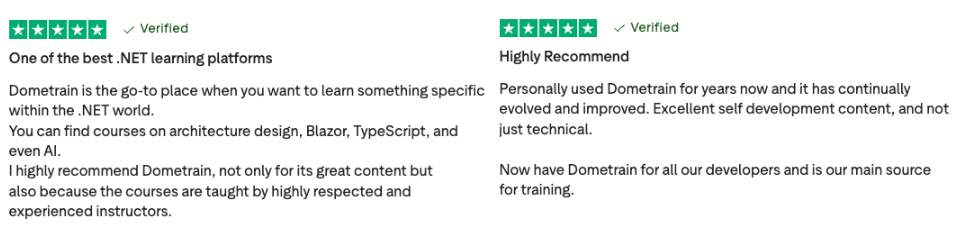
No platform is perfect, but when thousands of engineers independently arrive at the same conclusion, it’s hard to ignore.
Course Library: Bigger Isn’t Always Better
At first glance, Pluralsight’s 6,500+ courses sound impressive. Dometrain’s 100+ courses might seem small by comparison.
But size isn’t everything; what really matters is what you do with it.
Pluralsight: Big but Lacks Direction
Pluralsight’s library has grown massively over the years, largely by adding content breadth rather than depth. The result is a massive catalog where:
- Multiple courses cover the same topic at different quality levels
- It’s hard to know which course is current or authoritative
- Learning paths often link to overlapping or redundant material
For example, someone searching for a common topic like C#, .NET, or microservices can surface dozens of courses, some good, some bad, and some downright ugly.
For people just starting out, this creates decision fatigue. For experienced engineers, it creates uncertainty about whether a course reflects modern best practices.
Dometrain: Curated, Intentional, and Comprehensive
Dometrain takes the opposite approach.
Instead of trying to cover everything, Dometrain focuses on what actually matters in modern software engineering. Each course is:
- Designed to be comprehensive, not superficial
- Created by engineers actually working in the industry
- Positioned intentionally within a broader learning journey.
Rather than ten overlapping courses on the same topic, Dometrain creates one end-to-end resource you can trust.
The result? Less time browsing, and more time learning.

Course Updates: Staying Relevant in a Fast-Moving Industry
Software engineering doesn’t stand still. Frameworks evolve, language features change, and best practices shift as we learn more about scale, performance, and maintainability.
This is where large learning platforms may struggle.
Pluralsight’s Update Problem
A huge number of Pluralsight courses haven’t been updated since 2020 or earlier. While some fundamentals age well, many topics, especially cloud, frontend frameworks, distributed systems, and security, do not.
Outdated courses can:
- Teach deprecated patterns
- Miss modern tooling
- Reinforce habits that no longer scale well.
The problem isn’t just that content is old; it’s that learners often don’t realize it until they try to apply it at work.
Dometrain’s Commitment to Fresh Content
Dometrain’s content is fresher than a gym membership on January 1st. Courses are:
- Regularly reviewed
- Extended as new language features or patterns emerge
- Designed around modern tooling and workflows.
This matters because learning outdated approaches doesn’t just slow you down; it creates friction when you try to ship real software.
Learning Paths and Structure
Learning software engineering isn’t about isolated topics; it’s about understanding how concepts connect.
Pluralsight’s Fragmented Experience
Pluralsight does offer learning paths, but they don’t always take you where you need to go. Due to the size of the catalog:
- Paths often pull from multiple authors with different assumptions
- The difficulty curve can feel uneven
- Context is frequently missing between lessons
Many users complete a learning path and are left feeling unsure as to how everything fits together.
Dometrain’s Structured Approach
Dometrain’s learning paths are built with intentional progression in mind. Concepts build on one another, and assumptions are clear. You’re guided from fundamentals to advanced topics without feeling lost.
This is especially valuable for:
- Engineers leveling up into senior roles
- Developers transitioning into new domains
- Teams trying to align on shared practices
The structure stops you from feeling so overwhelmed about where to go next, so you can focus on understanding, rather than navigation.
Hands-on Learning and Real-World Application
Watching videos is easy; applying the knowledge is hard.
Pluralsight: Mostly Passive Learning
Many Pluralsight courses focus on explanation rather than application. While some include demos or exercises, hands-on projects are inconsistent and often optional.
This can leave learners with theoretical understanding but limited confidence.
Dometrain: Learning by Doing
Dometrain emphasizes practical application throughout its courses. The goal isn’t just to explain concepts, but to show:
- How decisions are made in real systems
- Why certain trade-offs matter
- How code behaves under real constraints.
This approach helps bridge the gap between “I understand this” and “I can use this at work”.
Learning Sticks When You Apply It
That’s why Dometrain courses are built around real-world engineering decisions, not just explanations.
Support Experience: Humans vs Bots
When you’re learning something complex, support matters.
Pluralsight’s Support Model
Pluralsight’s support has shifted heavily toward:
- AI chatbots
- Ticket-based systems.
Reviews frequently mention slow responses and unresolved issues, especially around billing and access.
Dometrain’s Human-First Support
Dometrain takes a more personal approach. When you reach out:
- You speak to a real person
- Questions are handled by people who understand the platform
- Feedback is actually used to improve content.
That difference shows up very clearly in user satisfaction.
Pricing and Value for Money
Pricing structures can get a bit confusing.
Pluralsight Pricing
Pluralsight currently offers:
- Core Tech: $30 a month (access to 3,900 courses)
- Specializations: $35 a month (adds AI, cloud, data, security)
- Complete: $55 a month (full access).
This tiering means you may end up paying more just to access content relevant to your role.
Dometrain Pricing
Dometrain offers:
- £33.33 a month on an annual subscription
- Full access to all courses
- Certifications of completion included.
The pricing cuts out the bullsh*t; it’s simpler, more transparent, and easier to justify, especially when you factor in course quality and update frequency.

Dometrain vs Pluralsight: What’s Best for Businesses?
Wondering which is the best option for teams? Let’s take a look.
Pluralsight for Businesses
Pluralsight is often positioned as a corporate standard, but many teams report:
- Low engagement after initial rollout
- Difficulty aligning learning with actual work
- Content that’s too broad to drive measurable improvement.
Dometrain for Businesses
Dometrain works well for teams because:
- Content aligns with real engineering problems
- Learning paths support consistent skill development
- Managers can track progress meaningfully
- Engineers actually want to use it.
For businesses, this means faster onboarding, fewer mistakes, and better retention, which is exactly what most teams struggle to measure with generic learning platforms.
Curious what this looks like in practice? See how Betsson Group strengthened onboarding and collaboration across their engineering teams with Dometrain.
Which Platform Is Right for You?
Pluralsight may still make sense if:
- You want extensive exposure across many topics
- You’re comfortable filtering and evaluating content yourself
- You’re ok with mixed quality and outdated material.
Dometrain is a better fit if:
- You want depth over volume
- You care about real-world applicability
- You value structure, clarity, and up-to-date practices
- You want learning that translates directly to better engineering work.
Many engineers who switch to Dometrain do so after feeling overwhelmed or underwhelmed by larger platforms.
The Bottom Line
Learning software engineering is already hard. Your learning platform shouldn’t make it harder.
Pluralsight offers scale, but that scale comes with trade-offs: fragmentation, outdated content, and a less personal experience.
Dometrain focuses on quality, clarity, and real-world relevance, helping engineers learn concepts and apply them with confidence.
If you’re serious about growing as a software engineer or helping a team do the same, Dometrain is designed to support that journey from start to finish.
About the Author

Nick Chapsas
© 2026 Dometrain. All rights reserved.