From Zero to Hero: Logging in .NET
Learn essential logging techniques in .NET to ensure reliable applications. This course covers built-in logging, structured logging with Serilog, and advanced features for production-ready code.


© 2026 Dometrain. All rights reserved.
Let’s be real: your time is your most valuable asset. As a developer, you are constantly bombarded with new frameworks, ‘AI-driven’ everything, and the looming threat of technical obsolescence. You need to learn, and you need to do it fast.
Most people default to Coursera because they recognize the names: Stanford, Google, and IBM. It feels safe. It feels ‘official’. But here is the cold, hard truth: Coursera is a digital landfill of academic leftovers. It’s where university lectures go to die. It’s built for the masses, not for the elite engineer who needs to ship high-performance code tomorrow.
Dometrain exists because we got tired of that crap. We’re here to turn you into a Senior Engineer, not a professional student. Here is how the two actually stack up.
Full disclosure: this comparison is written by Dometrain, but everything below is based on publicly available information and user feedback.
| Feature | Dometrain | Coursera |
|---|---|---|
| Trustpilot Rating | ⭐ 4.8 / 5 (Chef’s Kiss 👌) | ⭐ 1.3 / 5 (Absolute Bin Fire) |
| Number of Courses | 180+ (Highly Curated) | 10,000+ (Total Junk Drawer) |
| Quality Control | Strict. Only the best. | Minimal to Non-existent. |
| Course Updates | Instant. Bleeding Edge. | Whenever the Professor gets tenure. |
| Learning Structure | Practical & applied | Dry University Lectures |
| Hands-on Projects | The Standard (Code along) | Vague, Fill-in-the-blank |
| Support Experience | Talk to a Human | The Ticket-based Void |
| Pricing | £399.99/year | £298/year (Plus) |
| Certificates | Professional & Respected | University-backed |
If you want to know how a company actually treats its users, don’t look at its marketing; look at its Trustpilot reviews.
Trustpilot ratings:
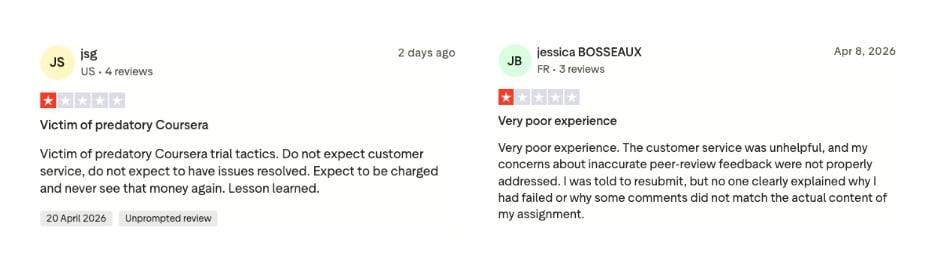
Coursera’s Trustpilot page reads like a horror novel written by a disgruntled accountant. Most reviewers feel completely let down. The biggest complaint? Their subscription model is a predatory mess. People report unclear billing, unexpected charges, and being billed for services they aren’t even using.
When you do have a problem, good luck finding a human. Their customer service is consistently roasted for being unresponsive, unhelpful, and nearly impossible to reach. And their refund process? It’s basically a game of “hide and seek” where Coursera always wins. If you enjoy fighting with chatbots about why you were charged £59 for a course you finished six months ago, you’ll love it here.
Read Coursera’s Trustpilot Reviews
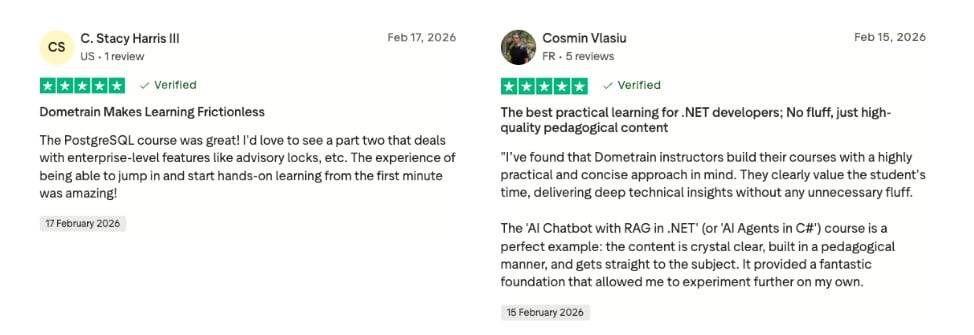
On the flip side, Dometrain is a ‘Chef’s Kiss’ experience. Why? Because we actually care about your time. Our reviews are packed with engineers praising the high-quality content that is immediately applicable to their daily work.
People love the fact that the recordings are clear, the structure is in-depth, and the instructors actually know how to code in a production environment. We don’t hide behind chatbots. If there’s an issue, you get it resolved.
Read Dometrain’s Trustpilot Reviews
Coursera loves to brag about having 10,000+ programs. That sounds impressive until you realize 9,000 of them are ‘Introduction to Hand-Painting’ or ‘History of the Byzantine Empire’. For an engineer, a library of 10,000 courses is a threat, not a promise. It means you have to dig through mountains of garbage to find one decent course on Cloud Architecture.
Dometrain has 180+ courses, and every single one is a banger. We are highly curated. We don’t accept every ‘expert’ who wants to record a video. We hand-pick Microsoft MVPs and Principal Engineers from Places like Microsoft and Datadog.
We don’t want to be the biggest; we want to be the best. If you want to find a course that actually helps you fix a race condition in a distributed system, you don’t need 10,000 options. You need the right option.
Browse Dometrain’s Course Library
Coursera partners with universities. That sounds prestigious, but universities move at the speed of a tectonic plate. Their updates are entirely down to the host. If a professor recorded a C++ course in 2018, that course is probably still sitting there, collecting digital dust, while the world has moved on to C++23.
The teaching style is ‘traditional classroom’, which is a fancy way of saying “shut up and listen to this person speak at a slide deck for 40 minutes.” It’s dry, it’s boring, and it’s an outdated way to learn a practical skill like engineering.

We update our courses as soon as they’re needed. When .NET 10 or C#14 drops, we aren’t waiting for a board of regents to approve a new syllabus. Our authors are active practitioners who live on the bleeding edge.
Our style is ‘Junior to Senior’. We skip the fluff. We don’t spend three hours on ‘what is a variable?’ We assume you’re smart, we assume you’re busy, and we get straight to the ‘why’ and the ‘how’ of production-grade software.
Coursera loves the word “Specialization.” They offer over 60 career learning paths for roles such as “Python Developer” and “Frontend Engineer.” On paper, this sounds great. In reality, it’s a commitment to a 3-to-6-month slog of academic theory.
These paths are designed like university semesters. You’ll get “Professional Certificates” from Google or IBM, which look nice on a resume if you’re applying for your first-ever internship. But if you’re an experienced dev, do you really want to spend half a year in a “Guided Learning Path” that moves at the speed of a dial-up modem? It’s a lot of hand-holding for people who are afraid to touch the keyboard without a rubric.
We don’t publish static, predefined roadmaps anymore because the “average learner” is a myth. Everyone starts at a different skill level, works in a different stack, and has different time constraints.
Instead of forcing you onto a rigid syllabus designed for beginners, Dometrain uses a conversational AI Learning Path Agent acting as your personal engineering mentor. You simply hit ⌘K anywhere on the site, type /learning-path followed by your target goal (e.g., “I want to move from building basic APIs to designing high-scale distributed systems”), and have a quick 30-second conversation.
The agent reads what you’ve actually finished on the platform, skips the fundamentals you already know, and targets your specific technical blind spots.
It asks about your daily tech stack and weekly availability, then builds ordered milestones with clear, plain-language explanations for why every course is there.
Your path isn’t carved in stone. If your career goals shift mid-way through or a new course drops that fits your trajectory, you reopen the conversation, and the agent instantly reshapes your route.
Coursera wants to keep you on their platform for six months so they can keep billing you. We want to give you the skills you need to get a promotion next month.
Coursera uses ‘peer grading’. Think about that for a second. You are paying a premium to have your work graded by another student who is just as confused as you are. It’s the blind leading the blind.
Many of their projects are vague and lack continuity. You’ll watch a lecture on “Loops”, and then the assignment is a ‘fill-in-the-blank’ exercise that feels like something from a primary school workbook. Or, worse, the assignment is a massive leap in difficulty with zero connection to the lecture. It’s demotivating as hell.
At Dometrain, hands-on isn’t an ‘extra’, it’s the standard. You learn by doing the thing. You code along with the instructor on real-world projects. No voodoo, no ‘magic’ code that appears on screen, you see the struggle and the solution.
Coursera support stinks. It’s ticket-based, slow, and frustrating. Users frequently report that tickets are closed without resolution. If you have a billing discrepancy or a technical glitch, you are essentially yelling into a void and hoping someone hears you.
We actually have people on the other end of the email. If you have a problem, you speak to a human. We get it resolved. We respect you as a professional, not just a subscription number.

This gets you access to 7,000+ courses. It sounds like a bargain until you realize you’ll spend half your time trying to figure out which courses aren’t total crap.
Yes, it’s a bit more. But let’s look at the ROI.
One Dometrain course on Modular Monoliths or C# Performance can save you weeks of debugging and potentially help you land a Senior role that pays £20k more per year.
You aren’t paying for “content.” You are paying for seniority equity. You’re paying to learn from the people who actually build the systems you use every day.
If you’re an Engineering Manager, you have a choice.
You can give your team a Coursera subscription and watch them earn “Professional Certificates” in “Project Management Foundations.” They’ll feel good, but your code quality won’t change.
Or, you can give them Dometrain Pro.
Dometrain is built for teams that need to ship. It helps you:
Coursera is for HR departments that want to tick a box. Dometrain is for Engineering Managers who want to build elite teams.
Let’s get right down to it:
| Choose Coursera If: | Choose Dometrain If: |
|---|---|
| ✅ You want a University-backed degree or certificate to put on your fridge. ✅ You are a complete beginner who wants to learn the “History of Computing.” ✅ You have an infinite amount of patience for peer-grading and dry lectures. |
✅ You are a professional software engineer who values your time. ✅ You want to learn the “Why” behind complex architectural decisions. ✅ You want to learn from the top 1% of practitioners in the industry. ✅ You want content that is updated as fast as the tech stack moves. |
Coursera is a massive, lumbering dinosaur. It’s great for the general public, but it’s a terrible place for an engineer to stay sharp. The lack of quality control, the outdated “lecture” style, and the horrific support experience make it a massive waste of energy.
Dometrain is lean, mean, and built for people who actually code for a living. We don’t have 10,000 courses, and we don’t want them. We have exactly what you need to become the engineer that companies are desperate to hire.
The choice is simple: Do you want a certificate, or do you want the skills?

Stop hoarding $10 courses. Compare Dometrain’s engineering depth vs Udemy’s marketplace noise for 2026.

Compare Dometrain vs Pluralsight on quality, updates, pricing, support, and real-world learning for engineers.